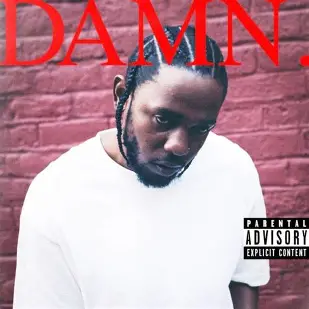
Kendrick Lamar – DAMN. (Album Review)
Kendrick Lamar’s DAMN. is the moment where a once-in-a-generation rapper
turns his gaze inward and lets contradiction sit without easy resolution.
If good kid, m.A.A.d city was the cinematic origin story and
To Pimp a Butterfly the sprawling political mural,
DAMN. is the stripped-down confrontation—Kendrick versus himself,
Kendrick versus America, Kendrick versus God.
Across fourteen tracks, he keeps the production lean and impact-driven.
Songs like “DNA.” and “HUMBLE.” ride menacing, minimal beats that feel built
for car speakers and festival stages, yet the writing never sacrifices density
for catchiness. On “DNA.” he flips Fox News soundbites into fuel, turning
criticism into proof of his power and complexity. The flows are relentless,
but what sticks is the way he threads pride, rage, and vulnerability into
the same breath.
The album’s core tension is spiritual and psychological. “FEEL.” is exhaustion
in audio form—Kendrick cataloging every way he feels abandoned, misunderstood,
and overburdened by expectation. “PRIDE.” and “HUMBLE.” sit side by side like
two sides of a sermon: one wrestling with ego and compromise, the other
weaponizing simplicity into a global hit that still carries a moral sting.
He’s not just preaching; he’s admitting how hard it is to live up to the
ideals he invokes.
Where Butterfly often looked outward at systems, DAMN. keeps
circling back to the self. “LOYALTY.” and “LOVE.” with Rihanna and Zacari widen
the lens to relationships, trust, and intimacy, but even there Kendrick sounds
like someone testing the limits of what stability can look like when fame,
trauma, and faith are all in the room. “LUST.” turns repetition into a theme—
days blurring together, distractions numbing the weight of the news cycle and
personal responsibility.
The sequencing reinforces the album’s obsession with duality. Life and death,
curse and blessing, weakness and strength—these ideas show up not just in
lyrics but in the way songs mirror and challenge each other. By the time you
reach “XXX.” and “DUCKWORTH.”, Kendrick is weaving personal history, American
violence, and divine coincidence into a narrative that feels both intimate and
mythic. “DUCKWORTH.” in particular plays like a short story about chance and
survival, reimagining his own origin as something that could have gone fatally
wrong with one different decision.
Sonically, DAMN. is more accessible than To Pimp a Butterfly
but not safer. The trap-leaning drums, sharp bass, and occasional gospel
textures make it easy to sit inside, yet the emotional temperature is high
and often uncomfortable. This is music that can soundtrack a party and a
crisis, sometimes in the same track. That dual function is part of why the
album has aged so well—it lives in everyday listening while still rewarding
close, deliberate attention.
What makes DAMN. special isn’t just its technical excellence, though
the rapping, hooks, and production are consistently top-tier. It’s the way
Kendrick allows contradiction to remain unresolved. He doesn’t present himself
as a flawless prophet; he’s a man trying to reconcile his gifts, his guilt,
his community, and his God. The result is an album that feels like a mirror—
of a country in turmoil, of a genre stretching itself, and of a person trying
to decide what it means to be “damned” or “blessed” when you carry both in
your DNA.
DAMN. stands as one of Kendrick Lamar’s most focused and emotionally
direct projects. It compresses his ambition into a tight, explosive package
without losing depth, proving that he can make stadium-level records that
still read like literature. For hip hop, it’s a modern classic; for Kendrick,
it’s the sound of a man wrestling with himself in public and turning that
struggle into art.
Join the Discussion